№ 01 · The product · Autumn 2026
Meal planning, starting with the food you already eat.
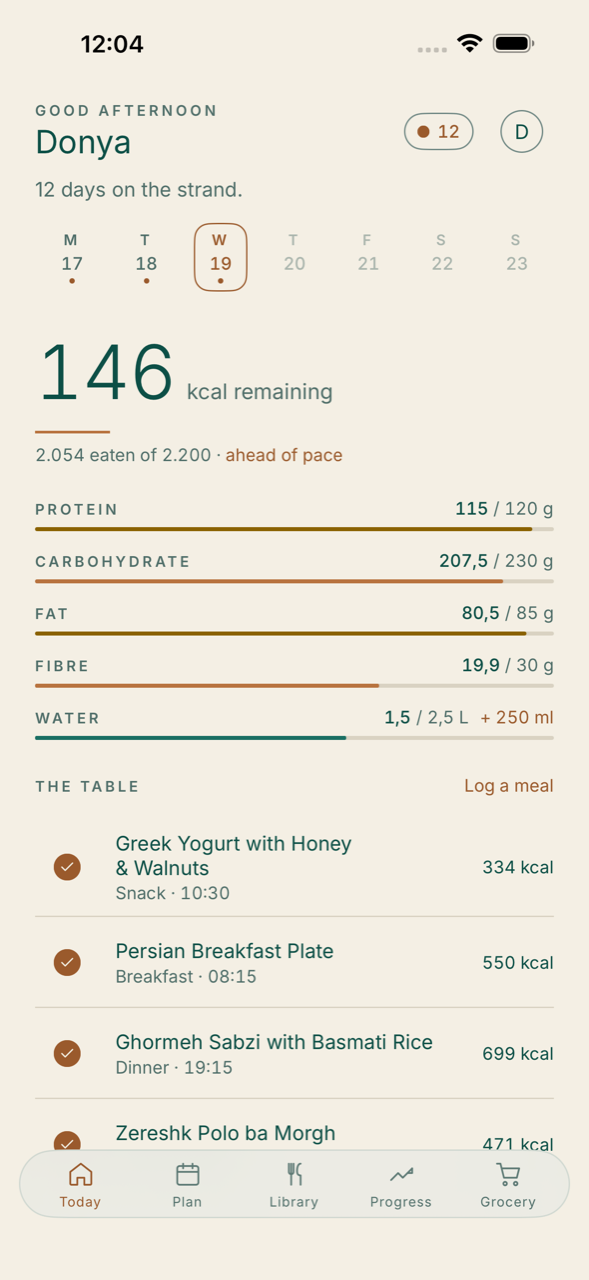
You bring the meals you already cook. Tanin plans the week around them so the macros land every day, with no chicken and rice five lunches in a row.


Tanin for iPhone · Free to download
Your week, composed.
01 · The planning problem
If any of these sound like your last six months.
I
Plans full of food you don't like.
Generic plans hand you quinoa bowls and tofu scrambles. You wanted the oats and rice bowls you already cook on repeat.
II
Calories right, split wrong.
Protein's fine. Carbs creeping low, fat creeping high. The training session feels it before the scale does.
III
Cut to maintenance, plan to redo.
You finish a cut, your calories shift, and suddenly every meal ratio you trusted is off. There's no plan that adjusts with you, so you start over from scratch.
IV
Same lunch, five days running.
Nothing was planned, so the chicken-and-rice loop wins again. By Thursday you're eating it cold over the sink.
02 · The planner
A week, planned in about 30 seconds.
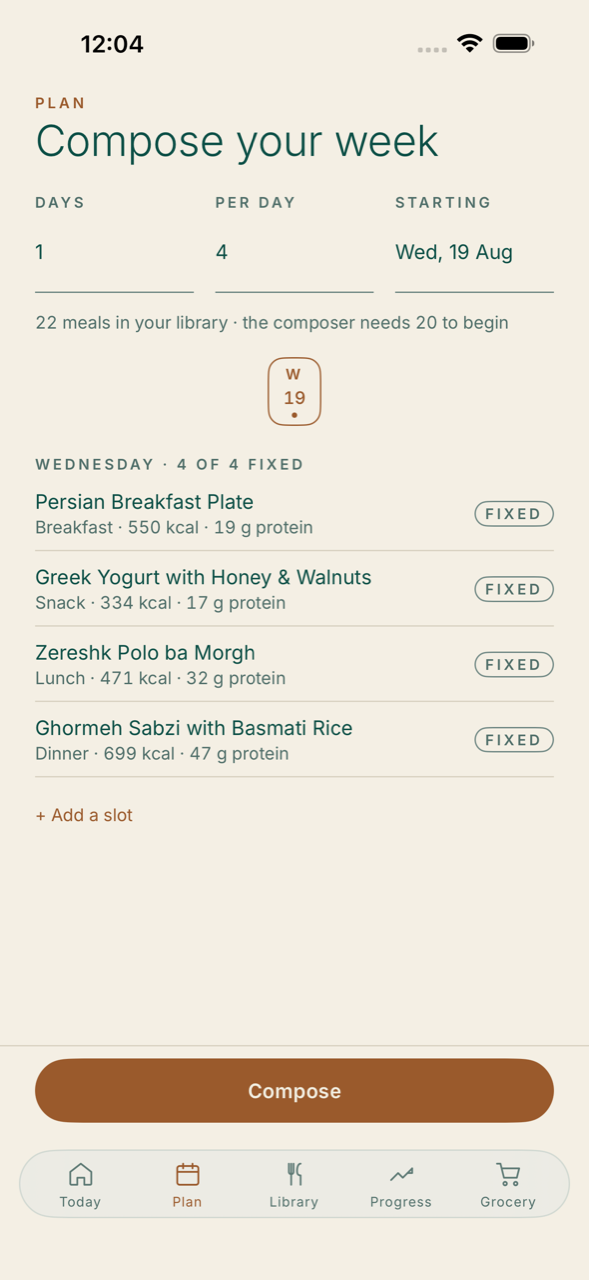
You get back a day-by-day schedule, with macros for every day and a grocery list that follows. Swap any meal. Compose the whole week again. The food is always what you already cook.
- Protein lands every day
- Pin your weekly favourites
- Water on the same screen
03 · How Tanin works
From empty library to a planned week, in three steps.
Step 01
Tell Tanin about you.
Weight, training frequency, goal. Tanin works out your calorie and macro targets from there, so you don't have to do the math. Adjust them later if you want. Most people set up once and leave it alone.
Step 02
Build a library of meals you actually cook.
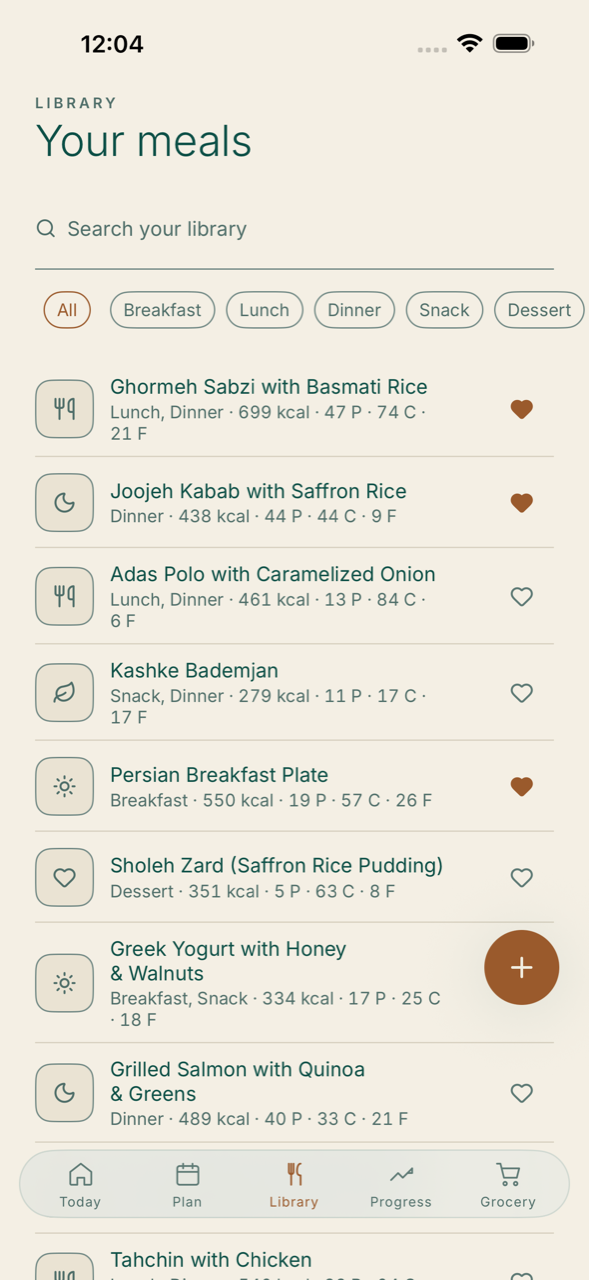
Your overnight oats, your post-gym wrap, your Sunday chili. Type the name, Tanin pulls the ingredients and macros for you. Add once, plan with them forever.
Step 03
Compose your week.
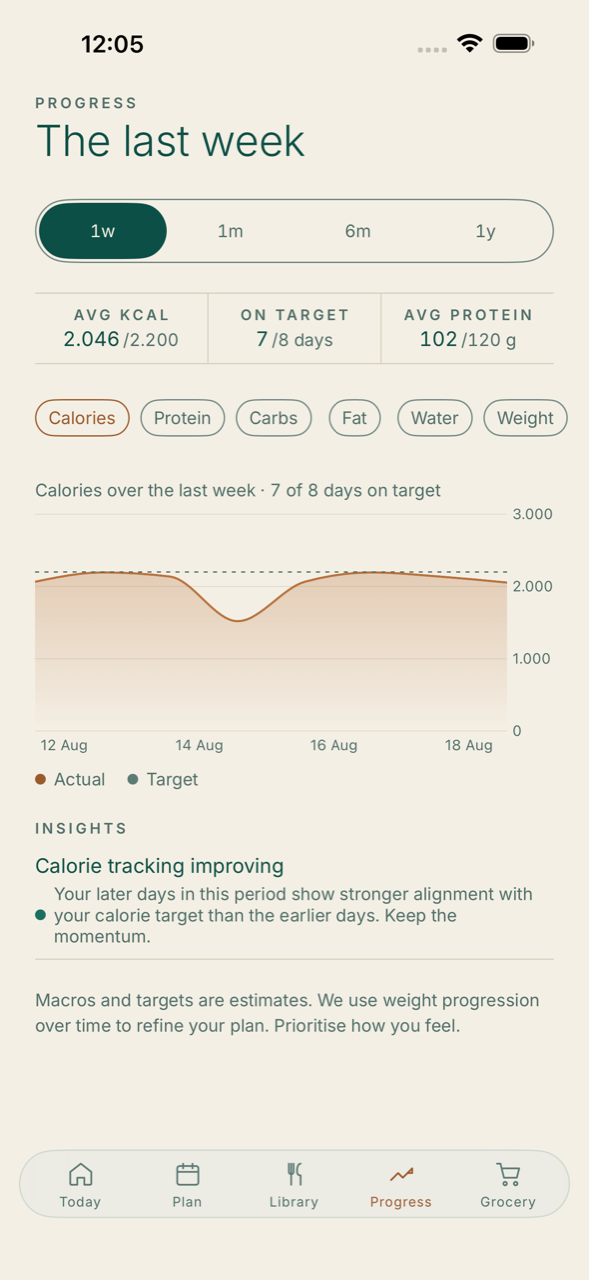
Every day adds up to your targets. Hate Tuesday's lunch? Tap swap. The whole week wrong? Compose it again. The grocery list rolls out with the plan, and as you tick meals off, the day's macros follow.
04 · How it actually works
You bring the meals. Tanin handles the planning.
On the outside it's simple: add your favourite dishes, share your goals, pick your week. Underneath, Tanin works out which meals go where so every day hits your numbers. Without making you eat the same lunch five times in a row.
After the plan lands, the rest is light. Tap each meal as you eat it and the day's macros update on their own. Swap any meal you don't want. Compose the whole week again if it doesn't fit. The grocery list keeps up with whatever you change.
The promise
Your week, composed.
Integer linear program · under a second to solve
05 · The promise
Eat what you love. Tanin plans around it.
Most meal plans assume you need garden salad to lose weight, or chicken and broccoli to build muscle. You don't. If pasta carbonara fits your macros, pasta carbonara is dinner.
Tanin is a diet planner that plans around the food you want to eat. Hand over the whole week, or pin a few meals you've already decided on (Friday pizza, Sunday roast, Tuesday's post-gym wrap) and let Tanin build around them. Either way, every day adds up to your goal. Cut, maintain, recomp, gain. Five macros, every day. Not just calories.
The result
A balanced diet that includes the food you love. Tanin tells you what to eat at each slot, every day. The grocery list follows.
06 · Where Tanin fits
Where Tanin fits.
vs
MyFitnessPal
MyFitnessPal is where you log what you ate. Tanin plans what you're going to eat. Different problem, different tool. We don't compete on logging.
vs
MacroFactor
MacroFactor adjusts your numbers based on your weight and what you've logged. Tanin sets your numbers from your goal and plans what to eat to hit them. Different jobs.
vs
Eat This Much
You already know what you love to cook: family recipes, ones you've nailed, dishes you make on autopilot. Tanin gives you a plan from your own food. Eat This Much gives you one from a database that isn't yours.
vs
“AI meal planners”
Most start with a recipe database and call themselves personal. Tanin starts with your library, and that's where personal actually begins.
07 · FAQ
Curiosity, answered.
08 · Membership
Three ways in. The first is complimentary.
Netherlands prices · VAT included
Tanin
free to download, no subscription
Enough to see whether the planning fits your food.
- 30 meals in your library
- Two compositions a week
- Full macro tracking
Member
or €94.99 a year, save 21 % compared with paying monthly
Compose your week again whenever your targets move.
- 80 meals in your library
- Unlimited compositions
- Full macro tracking
Patron
or €139.99 a year, save 22 % compared with paying monthly
For lifters whose library and macros keep moving.
- Unlimited meals
- Unlimited compositions
- Progress across days, weeks, months
Prices for the Netherlands, VAT included. Elsewhere the App Store shows your price, in your currency, before you subscribe.
14 days free for new subscribers, once per Apple Account. Then the plan's price until you cancel: payment is charged to your Apple Account when the trial ends. To stop it, turn renewal off in App Store settings.
Get Tanin on the App Store10 · Get Tanin
Plan your week. Eat what you love.
“My own gluten and dairy allergies made every meal plan a dead end. The first plan I built myself, with balanced macros, saved my body. Rebuilding it every two weeks broke me down. So I built the tool.”
11 · The science
The science behind the app.
How Tanin works out your targets
Tanin doesn't ask you for a calorie number. It works one out from your weight, height, sex, age, activity level, and goal. The base metabolic rate uses Mifflin-St Jeor, the equation that supplanted Harris-Benedict for modern accuracy. That gets multiplied by an activity factor for your training load. 1.2 if you barely move, up to 1.9 for hard training and a physical job.
Then the goal adjustment. The deficit or surplus comes from your chosen weekly weight change rate, with the body-fat-energy equivalence (a kilogram of body fat is about 7,700 kcal) doing the arithmetic. A 0.5 kg/week cut means a daily deficit of about 550 kcal. A 0.3 kg/week gain means a daily surplus of about 330. Body recomposition adds a 150 kcal surplus on top of maintenance. Small enough to keep weight stable, big enough to support muscle growth.
The protein target is anchored to your bodyweight, not your calorie budget: 2.0 g/kg for cuts and muscle-building, 1.8 g/kg for gain, 1.6 g/kg for maintenance, 2.1 g/kg for body recomposition. That keeps protein where it needs to be even when calories shift week to week. Fat sits between 0.6 and 0.7 g/kg with a percentage floor (25 to 30% of calories) for hormonal support. Carbs take the remainder. Fiber follows the DRI guideline at 14 g per 1,000 kcal.
For weight loss, the calorie target has a safety floor: at moderate loss rates the target won't drop below 1.05 × BMR; at aggressive rates, not below BMR itself. The point is to stop you sleepwalking into a deficit that compromises recovery.
You can override any number once you see it.
The figures are estimates and the targets suggestions — read the notice.
The nutrition science
Calories tell you the budget. Macros tell you what your body can actually build with it.
Protein drives muscle protein synthesis. The research consensus sits around 1.6 to 2.2 g per kg of body weight for trained lifters. Carbohydrate restores muscle glycogen, the substrate your hardest sets run on. Fat sustains the hormonal pathways behind testosterone, estrogen, and recovery. Chronic low-fat diets blunt performance. Fiber feeds the gut microbiome and slows gastric emptying. A 30 g fiber day feels different from a 10 g one.
Water
Water sits next to all of that. A 1 to 2% drop in body mass from dehydration measurably reduces strength output, endurance, and cognitive accuracy. Hydration also moves resting metabolic rate. Tracking it is not fussy. It is the cheapest performance variable you have.
The planning engine
The planning engine comes out of operations research at TU Eindhoven. It solves the whole week at once across all five macros, with an asymmetric penalty structure that protects protein and calorie floors.